This fit in with the constitutional requirement of Indonesia of its citizens having belief in only one God .
 |
| the Balinese are fine artistes and their delicate art works extends to architecture ,furniture ,idol temple making and fine arts of painting sculpting etc |

In 1962 Hinduism became the fifth state recognized religion .
In Bali the Trimurti deities of Hinduism of Shiva Brahma and Vishnu also has Eswara on top of all the three .
There are more than 20000 temples ( called Pura )in Bali ,each family has a Kula Dewa or family deity .
Balinese life is woven around their religion , heritage and their temples ,they do have a functional caste system but no untouchables probably a reflection of early Hindu life in India too .
 |
| several road junctions had stone lamps very similar to those seen in Kerala temples |
Most houses , shops , or roadsides are full of festive hangouts and flags made of ethnic material mostly from coconut fronds and bamboo ,innumerable festoons hang and sway delicately o the road sides and are cleverly made using local material an indication of the artistic nature of the Balinese,the cities and towns have huge statuettes from the Hindu scriptures of Mahabaratha and Ramayana .
 |
| Festoons decorate every street ,road ,front of houses ,malls and buildings |
there were small and large stone stupas in front of most shops to ward off evil and one would find offerings on plantain leaves which would have in t choclates fruits and even cigarettes on it which no one would ever touch
Hari raya Nyepi is the Hindu new year celebrated in Bali as a day of silence .
On new years eve the houses and the public places are cleaned food is cooked for two days ,in the evening as much noise as possible is made in order to drive away evil spirits ,Nyepi night is filled with fires song and light but the next day is one of total silence with people not venturing out of their house or cooking ,nothing works and even airports are closed ,tourists are asked to stick inside their hotels for the whole day and night .
Hari raya Galungan and Hari raya Saraswati are two other important festivals in Bali .
 |
| one of the beautiful temples of Bali with women in traditional dress carrying offerings |
Dewa took us first to an ethnic Balinese model village for tourists to get a glimpse of the Balinese way of life .
the village is called Pengalipuran
 |
| the wooden storehouses for storing grain is seen |

 |
| Pengalipuran or model Balinese village |
 |
| The street lined by houses in the model village |
 |
| Wearing traditional Balinese dress in the Pengalipuran |
 |
| the wide walkway ,no vehicles are allowed |


The whole village has been built in the traditional way with houses lining a broad walk with steps leading up to the temple at one end ,each house compound itself has smaller hutments with their red brick roofs .
The kitchen was in a separate room house from the living rooms ,many of the householders carried on with their work though some of them talked to visitors and tried to sell of souvenirs .
one does get a good glimpse of Balinese way of life ,strangely with the advent of tourism and modern gadgetry and comforts one would think that this way of life is restricted to interior villages and the more common folk ,but one would be wrong ,even the most modern model or receptionist or a DJ in a upmarket bar would go back to his or her sarong singing his or her devotional songs and carry those baskets on his or her head being every inch the Balinese is at his heart ,it is this tenacity by which the Balinese hold to their heritage that appealed to me the most ,whatever changes happened they never lose their soul which cannot be said the same of my country India where its tradition and heritage has almost became a shame for many !

The village had a temple at the top facing down ,most temples are closed or their sanctums are opened only when the priests are around ,but we could find some photo opps and one with Balinese dress too which we took for posterity
There was a hall filled with a Balinese group and they were in a class of sorts for religious training I think ,
Dewa was waiting for us and we got into the cool comforts of our car drinking ice cold water as the heat was quite sapping .
We were off to the mother of all temples in Bali Called Puru Beisakhi near mount Agung

( the principal volcano of Bali ) it was really a temple complex with more than 23 separated but related temples built at an elevation of 1000 meters and in six levels .The largest and the central of the temples is called Pura Penturan Agung
 |
temple complex of 23 temples
|
It dates back to prehistoric times and been worshiped in from 1294

in 1963 the volcano became active and more than 1700 people died but the lava missed the temple closely which is considered by the Balinese as a miracle
 |
Mount Agung
 |
on the way to the temple
|
|
the only issue is as you find in many reviews there is an extortion by certain priest guide nexus which insists on tourists needing guides fortunately ours was not that demanding and we came out unscathed though one needs to rent out a sarong which had to be worn to go inside ,the temple itself is at several levels and the Gods too progressively become higher as one goes up ,
I missed the top most story being lazy to climb steps in the warm day but my wife as usual made it and said that was the most beautiful part and dedicated to the ultimate Ishwara himself !
most of the devotees were in pure white the men sporting a Balinese head gear and the women thier very pretty dresses ,there was a sense of peace and happiness in them ,temple visits are occasions where they come with their families and friends and there was no rush in it as seen in many Indian temples ,the main difference was there was no noticeable altars to view idols in fact many pedestals had just umbrellas adorning empty spaces which again showed the Balinese uncannily hit on the real nature of Adwaitic Hinduism and are beyond idol worship ,were the past Hindus like this and did the present form as seen in India come later of course this blog is hardly the place to debate on superiority of which ,each to his own
 |
| temple art |
 |
| Beisakhi temple |
 |
| The split entrance is seen in many Balinese temple entrances ,here it is called the Candi Bentar and the second level gate is called Kori Agung |
 |
| The priest distributes offerings to the devotees all dressed in pristine white |
 |
| a view from the top of the steps |
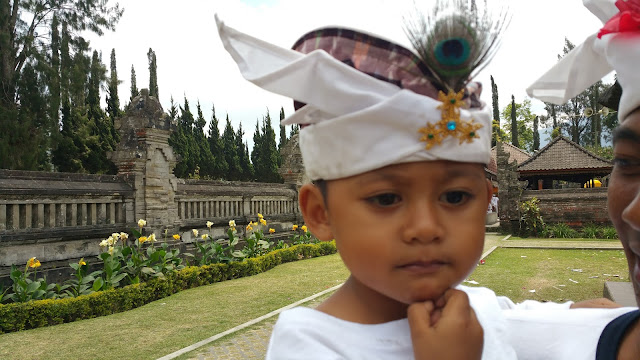 |
a lovely Balinese child in the temple in traditional garb
|
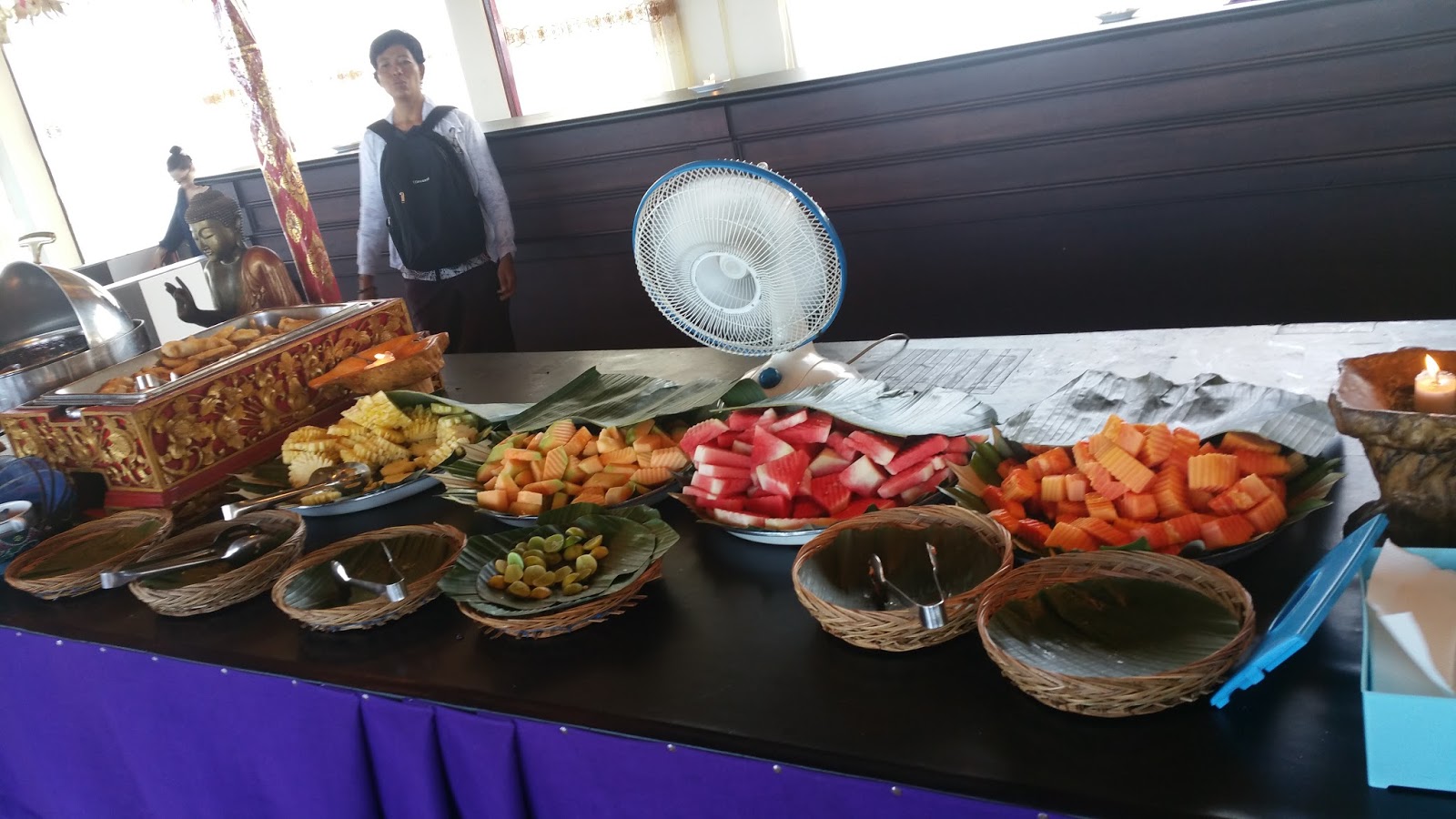
It was time for lunch and Dewa took us to a bug hotel known for its Balinese buffet lunch ,there were a lot of tourists and we just manged to find a seat ,one could see the Mount Agung in the back ground ,the buffet spread was big and we got out of lunch feeling full and was accosted by a bunch of touts and souvenir sellers who manged to do their jobs quoting good bargains in American dollars as Indonesian money would be in astronomical figures .
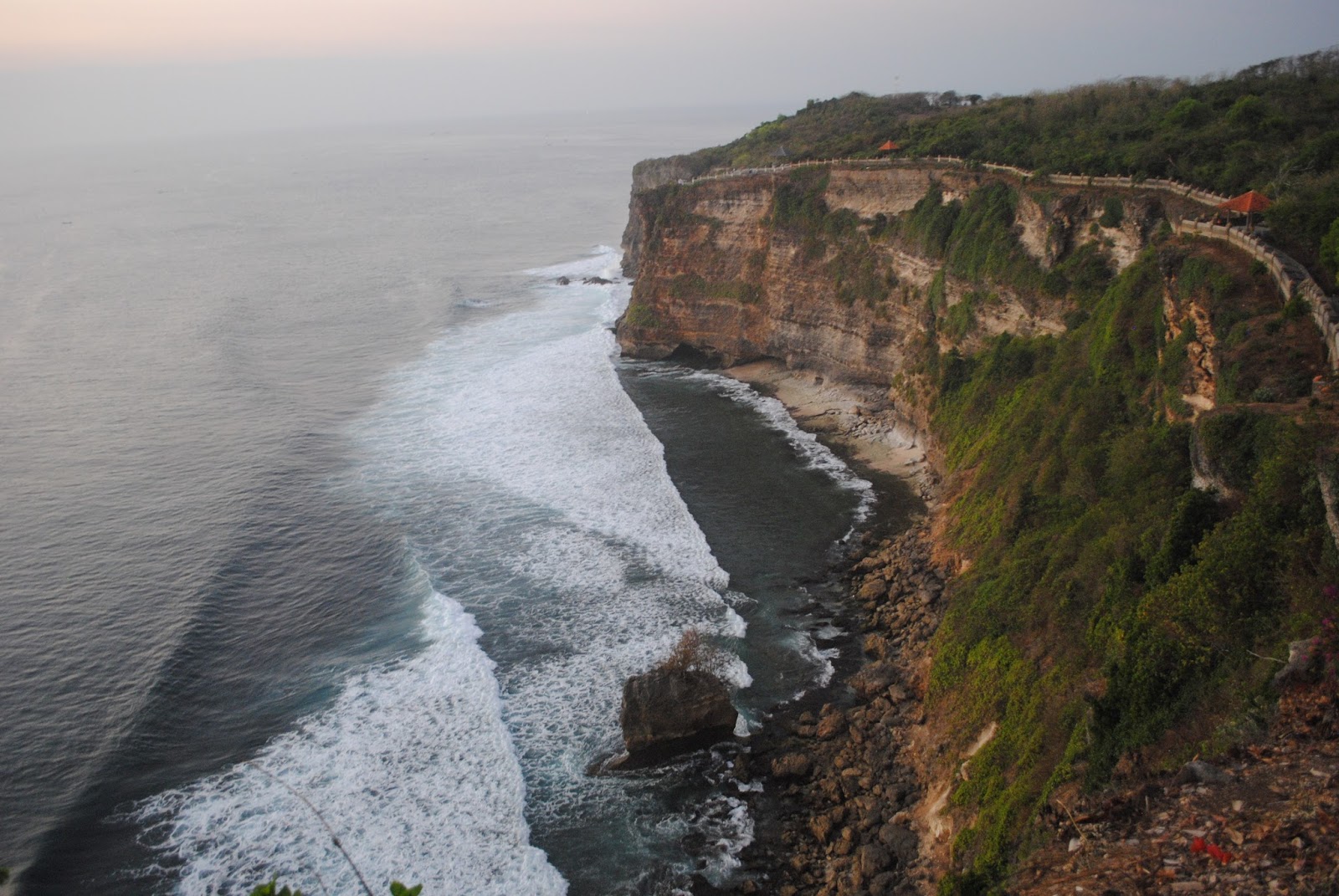
We then decided to go to the Uluwatu temple in the Bukit peninsula ,it is located on cliffs 70 meters above the crashing waves of the Indian ocean and is well known for its spectacular sunsets ./most temples in Bali ask for entrance fees and are tourist attractions for the foreigners while being spiritual centers for the locals ,cleverly marketed spirituality which I appreciate .,
there are plenty of monkeys in this temple and are known to grab cameras and bags and hence one has to exercise caution as one

gets absorbed by its beauty ,we did miss the sunset and it soon became dark but we could capture some excellent
snaps
 |
| The sentinel gaurdian of Uluwatu |
We then returned back exhausted to Kutta and had a good sleep .
of course I have not mentioned the excellent beaches and surfing in the peninsula as our tour was more focused on Balis temples this time
Morning saw Dewa back with us ,this day we planned to visit two important temples one was Tanah lot on the beach and the other was Ulundawa on the side of a lake ,
Tanah lot means land sea built by Javanese sage Dang Hyang Nirartha in 16 th century ,the main diety is Dewa Baruna or Batara segara the sea Gods and the sage himself is also worshiped here .
At the base of the temple island mythology suggests venomous sea snakes protect it ,in 1980 the crumbling temple due to sea erosion was renovated with Japanese funds .
We went inside one of the temples though the one inside the sea could not be reached due to the high tides ,surfers were seen swimming on the sea .
the temple on a rock out in the sea were so picturesque and one could imagine how it would look in sunset ,we were surprised to find out the rock was a carefully constructed artificial outcrop which had replaced a crumbling rock a few years back ,cleverly engineered to look like the original while being strong too a real feat in conservation .
The touts ,guides ,vendors were all over but are cheerful and not at all demanding ,they fit in to the place so well ,the real temple visitors too were in plenty dressed in white muslin and neat and the women were graceful in their sarongs with offerings carried daintily on their heads .
There was so much of peace and quietude in their movements and the place was serene and peaceful ,the line of shops included upmarket branded shops restaurants and studios making brisk business .
Artistes did their work in front of the tourists and the place was a treasure house for artistic works ,
 |
| making and selling art |
We got back into the car and sped to a heritage restaurant to be served with authentic Balinese cuisine
 |
Balinese fish and rice
 |
| Sattu |
|
 |
| A temple function with procession |
 |
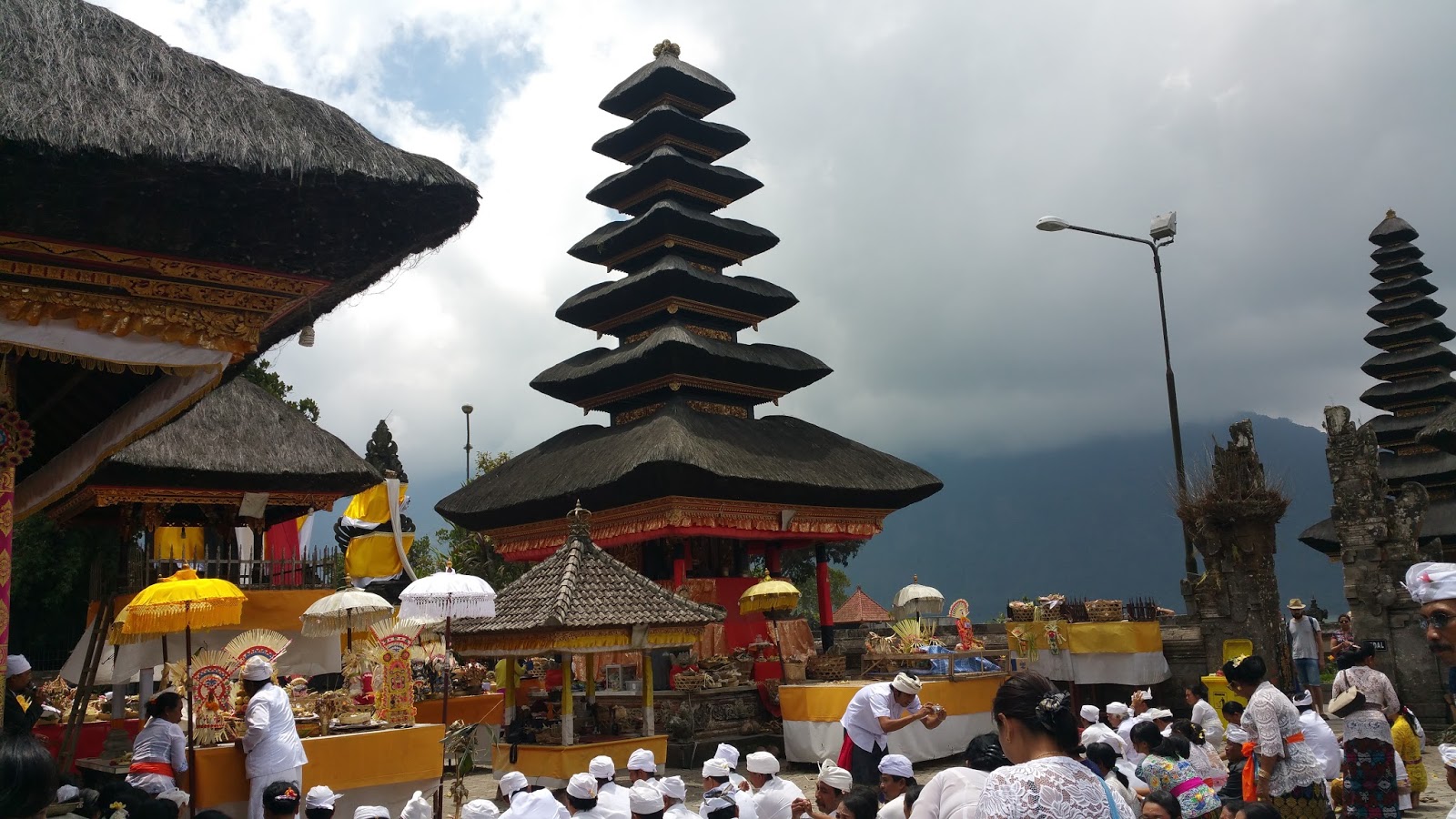
| the step like pagodas were typical of balinese temple architechture and to a small extent did resemble temples of Kerala ,umbrellas shaded empty pedestals with offerings for the invisble Gods |
we sped to our last temple the famous ulundanu about 50 km fro Densapar a shaivite temple on the shores of Lake Bretan in the mountains near Bedugul at 1200 meters above sea level .built in 1663 this temple is for offerings to the lake Godess Dewi Dhanu .or Laksmi ,other Gods are Brahma and Buddha .
Shiva and consort Parvsthi are the main deities Vishnu and Brahma and their temples all have tiers in descending orders
After returning from here we sped to our hotel in Seminiak area a more upmarket locality and into a bigger and sophisticated one with an infinity pool
we lazed in the next morning after a hearty breakfast and an indulgent swim as we had to leave Bali in the evening with a sad heart !!